 11
11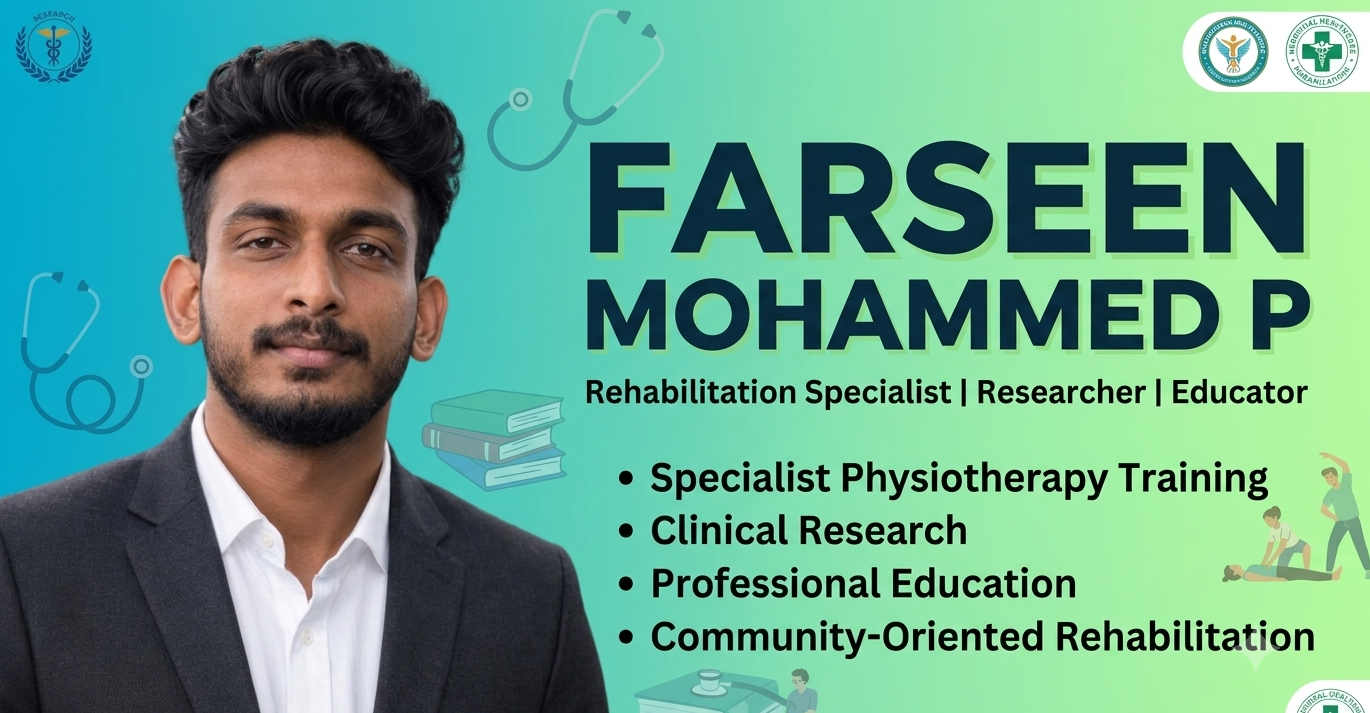
Mangaluru, Karnataka: Neurological rehabilitation can involve patients with very different conditions, symptoms, functional limitations and recovery goals. As a specialist physiotherapist in neurosciences and clinical researcher, Farseen Mohammed P has developed his professional interests around the principles of neurological assessment, rehabilitation and evidence-based physiotherapy.
His academic and clinical training has provided exposure to neurological disorders while his research activities have encouraged a broader understanding of rehabilitation interventions and functional outcomes.
Neurological conditions can affect individuals in different ways. Two people with the same diagnosis may have different levels of strength, balance, coordination, mobility and independence.
For this reason, rehabilitation commonly requires consideration of the individual’s functional limitations and rehabilitation objectives.
Farseen’s postgraduate specialization in neurophysiotherapy and neurorehabilitation has provided a foundation for understanding these different rehabilitation requirements.
Farseen completed his Master of Physiotherapy in Neurosciences at Yenepoya Physiotherapy College, Yenepoya (Deemed to be University), Mangaluru.
His postgraduate education followed his Bachelor of Physiotherapy degree from the Co-operative Institute of Health Sciences, Thalassery.
The progression from general physiotherapy education to specialized neuroscience training allowed him to develop a more focused professional interest in neurological rehabilitation.
During his postgraduate clinical training at Yenepoya Medical College Hospital, Mangaluru, Farseen gained experience with patients presenting with several neurological conditions.
His clinical exposure included:
Each of these conditions can present different rehabilitation challenges, reinforcing the importance of individualized clinical planning.
A rehabilitation programme generally begins with understanding the individual’s functional abilities and limitations.
Depending on the condition, physiotherapy may address aspects such as movement, strength, mobility, balance, coordination and participation in daily activities.
Farseen’s training in neurological physiotherapy has included approaches designed to support functional rehabilitation and motor recovery.
One component of Farseen’s clinical training has been task-oriented training.
Task-oriented rehabilitation emphasizes meaningful movement and activities related to functional performance.
His exposure to this approach forms part of his broader training in neurological rehabilitation.
Farseen has also developed experience with the Motor Relearning Programme, an approach used in neurological rehabilitation to facilitate the relearning of functional movements.
His interest in motor learning is further reflected in his ongoing research activity.
He is involved in a scoping review examining tracking-based motor training for motor learning and functional recovery after stroke.
Another component of his professional training is Neurodevelopmental Treatment (NDT).
Farseen has undertaken NDT-related training covering functional improvement in cerebral palsy and neuromotor disorders, along with additional hands-on rehabilitation education.
These experiences have expanded his exposure to different approaches within neurorehabilitation.
Therapeutic exercise is another important element of Farseen’s professional interests.
His postgraduate research examined eccentric versus concentric strengthening in people with subacute stroke.
The study focused on functional mobility, providing an example of how exercise interventions can be investigated in relation to individual rehabilitation outcomes.
Individualized rehabilitation also requires clinicians to remain informed about available evidence.
Farseen has developed experience in systematic reviews, scoping reviews and evidence synthesis.
His research in stroke and Parkinson’s disease demonstrates an interest in examining available evidence rather than relying solely on established assumptions.
In 2026, he also completed a five-day hands-on international-level workshop in systematic review and meta-analysis conducted by IIRA, Mumbai.
Farseen’s research contribution in Parkinson’s disease provides another example of his interest in rehabilitation planning.
He contributed to the scoping review:
“Timing of Dopaminergic Medication Relative to Physiotherapy Delivery in Adults with Parkinson’s Disease: A Scoping Review.”
The study considers the relationship between dopaminergic medication timing and physiotherapy delivery.
He served as the second author and corresponding author.
Stroke rehabilitation remains one of the major areas of his research activity.
His postgraduate dissertation investigated strengthening approaches and functional mobility in subacute stroke.
He subsequently contributed to systematic-review research examining the effectiveness of eccentric strengthening interventions following stroke.
His related presentation at SYNERGOS 2026 received the First Prize in the Postgraduate Category for Oral Paper Presentation.
Individualized rehabilitation can also involve considerations beyond the treatment session.
Patients may need guidance and support as they transition from hospital-based care toward home and community environments.
Farseen addressed this aspect during his CME session for nursing professionals at St. Joseph’s Mission Hospital, Anchal.
His session, “Life After Discharge: Physiotherapy-Guided Secondary Prevention and Community Reintegration,” focused on rehabilitation after discharge and community reintegration.
Rehabilitation can involve collaboration between physiotherapists and other healthcare professionals.
Farseen’s professional activities have included interaction with nursing professionals through CME education and participation in institutional academic activities.
His postgraduate diploma in nutrition and ACE Health Coach Certification also provide complementary perspectives related to health, exercise and rehabilitation.
Although neurological rehabilitation remains central to his career, Farseen’s research interests extend into other areas.
His ongoing work includes research related to:
This wider research exposure contributes to a broader understanding of rehabilitation science.
Farseen’s professional development includes specialized training in neurological rehabilitation, stroke management, clinical research and evidence synthesis.
His continuing education demonstrates an effort to develop both clinical and research competencies.
This combination can support an approach in which rehabilitation decisions are informed by clinical assessment as well as available scientific evidence.
At the center of individualized rehabilitation is the recognition that patients have different functional needs and personal goals.
A research-informed physiotherapy approach can help clinicians consider available evidence while adapting rehabilitation strategies to individual circumstances.
Farseen’s academic specialization, clinical training and research interests have collectively contributed to his professional development in this direction.
As neurorehabilitation continues to evolve, individualized treatment planning, functional outcomes and evidence-based practice are likely to remain important components of clinical physiotherapy.
Farseen Mohammed P is developing his career across these areas through postgraduate specialization, neurological clinical training, research publication, scientific presentations and continuing professional education.
His professional journey reflects an emerging focus on individualized neurorehabilitation, functional recovery and research-informed physiotherapy, combining clinical learning with an ongoing interest in scientific evidence.